


A respiratory rate higher than 27 breaths per minute is the most significant predictor of cardiac arrest in hospital wards, yet this vital biomarker often remains misunderstood. You may find yourself checking your data and wondering, what is a good respiratory rate UK, only to be met with conflicting ranges or vague explanations from your fitness tracker. It is common to feel unease when your breathing shifts or when technology presents data without clinical context. We believe clarity is the foundation of health mastery; you deserve to understand the precise signals your body is sending.
This guide provides the scientific standards for a healthy respiratory rate and explains how continuous monitoring can predict illness before physical symptoms emerge. You will gain a clear understanding of UK health ranges and learn how to use personal data for early detection of physiological stress. By the end, you will have a robust framework for long-term monitoring that replaces uncertainty with data-driven confidence. We are moving toward a future where wellness is a system to be mastered, and it begins with the rhythm of your breath.
Key Takeaways
- Identify the standard UK adult range of 12 to 20 breaths per minute to establish a clear benchmark for what is a good respiratory rate UK.
- Understand the biological mechanisms of breathing, including how your respiratory centre reacts to carbon dioxide levels to maintain homeostasis.
- Distinguish between static manual measurements and dynamic baselines to overcome the inaccuracies caused by the 'observer effect' during self-assessment.
- Learn the precise methodology for measuring respiratory frequency whilst at rest to ensure your data remains clinically significant.
- Discover how theBand and the Cura+ AI Platform utilise predictive intelligence to identify subtle physiological shifts before illness becomes symptomatic.
Understanding Respiratory Rate: What Constitutes a 'Good' Result in the UK?
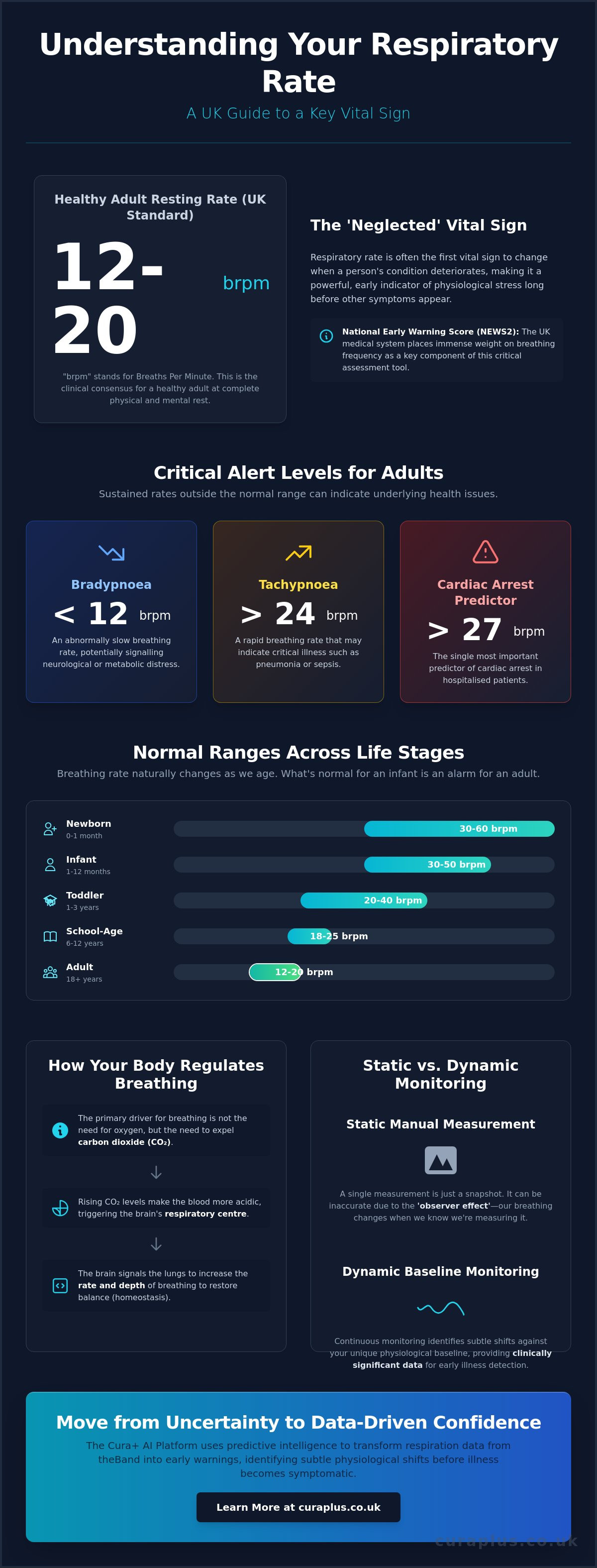
Your Respiratory rate is the number of breaths you take in a sixty-second window, typically measured whilst you are at a complete physical and mental rest. In the United Kingdom, the clinical consensus for a healthy adult is between 12 and 20 breaths per minute (brpm). This metric is a fundamental pillar of your physiological profile. It represents the delicate balance between your body's oxygen requirements and its need to expel carbon dioxide. Whilst the 12 to 20 range is the standard benchmark, it's essential to distinguish this resting frequency from the rates seen during light activity or emotional stress, which naturally elevate your breathing as the body responds to increased metabolic or neurological demands.
When investigating what is a good respiratory rate UK, you must understand that 'good' is often a subjective term defined by your personal physiological baseline. A professional athlete may naturally sit at the lower end of the spectrum, whilst an individual recovering from a minor ailment might see a sustained, subtle elevation. The UK medical community increasingly focuses on these individual deviations rather than static averages. A single measurement is merely a snapshot; true insight comes from understanding how your rate fluctuates against your unique 'normal' state.
Normal Ranges Across Different Life Stages
Physiological requirements change significantly as we age, and what is considered healthy for an adult would be cause for alarm in a child. Newborns (0-1 month) typically breathe at a rate of 30 to 60 brpm, whilst infants (1-12 months) range between 30 and 50 brpm. As children grow, these rates gradually stabilise: toddlers (1-3 years) average 20 to 40 brpm, and school-age children (6-12 years) settle between 18 and 25 brpm. Amongst the elderly, the 'good' range may shift slightly higher due to changes in lung elasticity. Clinically, a rate exceeding 20 brpm in an adult often suggests they are unwell, whilst a rate over 24 brpm, known as tachypnoea, may indicate critical illness. Conversely, bradypnoea occurs when the rate drops below 12 brpm, potentially signalling neurological or metabolic distress.
Why Breath Rate is the 'Neglected' Vital Sign
Respiration is frequently overlooked in favour of more popular metrics like heart rate or blood pressure, yet it is often the most sensitive indicator of health. Within the UK medical system, the National Early Warning Score (NEWS2) places immense weight on breathing frequency because it is often the first vital sign to change when a patient's condition deteriorates. Research indicates that a respiratory rate higher than 27 brpm is the single most important predictor of cardiac arrest in hospital wards. Subtle shifts in your breathing are often the earliest signs of autonomic nervous system changes, acting as a quiet alarm for the body long before fever or pain becomes apparent.
The Physiology of Breathing: How Your Body Regulates Every Breath
Breathing is an elegant, involuntary function orchestrated by the brain's respiratory centre. This neurological command post, located within the medulla and pons, monitors blood chemistry with surgical precision. Whilst we often associate breathing with oxygen intake, the primary driver is actually the concentration of carbon dioxide in the bloodstream. As CO2 levels rise, the blood becomes more acidic, triggering the brain to increase the rate and depth of ventilation. This process ensures the body maintains homeostasis, a state of internal stability where the heart and lungs operate in a synchronised rhythm. Understanding this regulation helps clarify what is a good respiratory rate UK because it shows that your breath is a reactive signal rather than a static number.
Respiration is one of the four primary vital signs, serving as a real-time window into your metabolic health. External variables can temporarily heighten this response. For instance, urban air quality in major UK cities can force the body to adjust its breathing patterns to compensate for particulates. Similarly, even modest changes in altitude can shift your baseline. By observing these trends on the Cura+ AI Platform, you can begin to master your body's complex internal systems.
Autonomic Nervous System Control
The autonomic nervous system (ANS) governs the rhythm of your breath through two competing branches. The sympathetic system, often called 'fight or flight', accelerates breathing to prepare for perceived physical or emotional threats. In contrast, the parasympathetic system promotes 'rest and digest' behaviours, slowing the rate to conserve energy. Chronic stress or anxiety can trap the body in a sympathetic state, leading to persistent, shallow breathing that disrupts your natural baseline. This is why using a wearable for tracking stress patterns is essential; it reveals how your mental state physically manifests in your respiratory data.
Factors That Influence Your Resting Rate
Several lifestyle and environmental factors can influence your resting frequency. Sleep quality is paramount; conditions like sleep apnoea cause repeated, often unnoticed, interruptions in breathing that spike the respiratory rate and strain the heart. Stimulants common in British culture, such as caffeine from morning tea or coffee, can temporarily increase the rate, whilst alcohol acts as a depressant that may slow it down. Conversely, consistent cardiovascular exercise strengthens the respiratory muscles and improves lung efficiency. Over time, this leads to a lower, more efficient resting rate, which is a hallmark of high-level physiological performance.
Static Numbers vs Dynamic Baselines: Why One Measurement is Not Enough
A single data point is a snapshot, not a strategy. Relying on an occasional manual count to assess your health is often fundamentally flawed due to the 'observer effect'. This phenomenon occurs when the simple awareness of being monitored causes you to subconsciously alter your breathing rhythm, making it nearly impossible to capture an authentic resting state. Whilst clinical ranges offer a useful starting point, true clarity comes from understanding your unique trends. This is why the adoption of predictive health wearable UK technology is so transformative; it captures authentic, background data without conscious interference.
When asking what is a good respiratory rate UK, you may find that 18 breaths per minute is technically 'normal' according to general standards. However, if your personal resting baseline is 12, that same 18 represents a significant 50 per cent increase in respiratory demand. This shift could be a vital early warning of physiological stress or impending illness, yet it would be entirely ignored by a one-size-fits-all approach. We view health as a complex system to be mastered, and that mastery requires context that a single number cannot provide.
The Danger of 'Snapshot' Health Data
'White Coat Syndrome' frequently causes respiratory rates to spike in medical environments, leading to data that does not reflect your daily reality. Seasonal shifts in the UK, such as the sudden drop in temperature or the dry air caused by central heating, can also create minor fluctuations that are easily misread during a single check. Continuous 24/7 monitoring allows you to see past these temporary deviations. Advanced sensors provide a steady stream of intelligence that periodic manual checks simply cannot match, replacing uncertainty with a clear narrative of your wellbeing.
Identifying Your Unique Physiological Baseline
Your baseline is the biological signature of your body at its most stable. It typically takes 7 to 14 days of continuous monitoring to establish this foundation and understand your body's natural rhythm. During this window, the Cura+ AI Platform works to filter out the 'noise' of daily life, such as temporary stress or physical exertion, to find the true underlying signal. Understanding how to build a health baseline empowers you to transition from reactive symptom management to proactive health optimisation.
How to Monitor and Improve Your Respiratory Efficiency
Monitoring your breath requires more than a casual glance at a clock. To accurately determine what is a good respiratory rate UK for your specific physiology, you must adhere to a rigorous measurement protocol. Breath is inherently sensitive to attention. The moment you focus on your inhalation, your brain often shifts from involuntary to voluntary control, which can skew your data. Achieving a true resting measurement requires a state of physical stillness and mental distraction, ensuring the respiratory centre operates without conscious interference.
Stabilising a fluctuating rate is not merely a matter of observation; it is a process of active refinement. Lifestyle adjustments, such as regulating caffeine intake and improving sleep hygiene, provide the foundation for a steady baseline. However, targeted breathwork offers a more direct path to physiological optimisation. By training the autonomic nervous system to remain in a parasympathetic state, you can lower your resting frequency and improve your overall respiratory efficiency. To gain the most from these practices, we suggest utilising theBand to see how your interventions translate into measurable health gains.
Techniques for Accurate Manual Measurement
Precision is paramount when measuring vital signs manually. You should always count for a full 60 seconds rather than taking a shorter sample and multiplying it. Breathing is not always perfectly rhythmic, and a 15-second snapshot can easily miss subtle pauses or accelerations. For the most accurate result, have a partner observe your chest rise whilst you are distracted, perhaps by reading or listening to music. Beyond the raw count, you must also assess the quality of each breath. Note whether the respiration feels shallow or deep, and observe if there is any visible effort or use of accessory muscles in the neck and shoulders, as these are critical indicators of physiological strain.
Breathing Exercises for Long-Term Health
Specific exercises can fundamentally alter your respiratory profile. Box breathing, which involves inhaling, holding, exhaling, and holding for equal four-second counts, is a powerful tool for recalibrating the nervous system. Similarly, diaphragmatic breathing encourages deep, efficient gas exchange in the lower lobes of the lungs. These techniques expand your functional lung capacity, allowing your body to meet its oxygen needs with fewer, more effective breaths. We recommend utilising biometric tracking for wellness to observe the real-time impact of these exercises on your resting rate, turning abstract practice into a data-driven journey toward self-optimisation.
Predictive Intelligence: Transforming Respiration Data with theBand by Cura+
Static health ranges provide a necessary foundation, but true physiological mastery requires the integration of high-resolution, continuous data. theBand by Cura+ serves as an advanced sentinel for your biology, monitoring over 15 biomarkers with surgical precision. Whilst you may begin your journey by asking what is a good respiratory rate UK, the Cura+ AI Platform moves beyond generic benchmarks to define what is optimal for your unique body. By establishing a dynamic baseline, the system identifies minute deviations that would be invisible to the naked eye or a periodic manual count. This represents a visionary shift from reactive symptom management to a model of proactive health intelligence.
In this high-stakes journey toward self-optimisation, data privacy is as vital as data accuracy. Your biometric insights are protected by sophisticated encryption within the Cura+ ecosystem, ensuring that your personal health narrative remains secure. We view health as a complex system to be understood and mastered, and our technology is designed to act as your sophisticated guide in that process. By replacing uncertainty with clarity, we empower you to take command of your long-term wellness with confidence and calm control.
AI-Driven Early Illness Detection
A rising respiratory rate is often the earliest physiological signal of an impending viral onset, frequently appearing before you feel the first signs of fatigue. Research indicates that for every degree body temperature rises during a fever, the breathing rate can increase by approximately four breaths per minute. theBand captures these subtle shifts whilst you sleep, allowing the Cura+ AI Platform to issue real-time alerts that prompt you to prioritise rest or adjust your schedule. This early detection window is a critical component of modern wellness, providing the opportunity to mitigate physiological stress before it escalates. This proactive approach is further detailed in our guide on how to use a wearable for tracking immune health.
Integrating Respiration with 15+ Biomarkers
Respiration data gains its greatest power when synthesised with other vital signals. theBand combines your breathing frequency with skin temperature, blood pressure trends, and heart rate variability (HRV) to create a comprehensive biological narrative. These data points are processed by the Cura+ app to generate a 'Health Intelligence' score, a refined metric that reflects your current state of physiological readiness. This holistic view ensures that a change in your breath is never interpreted in isolation, but rather as part of a synchronised internal rhythm. We invite you to join the future of wellness by exploring theBand by Cura+ and discovering the insights hidden within your own data.
Master Your Physiological Rhythm through Data
Mastering your health requires moving beyond the basic question of what is a good respiratory rate UK and into the realm of personalised, predictive intelligence. We've established that whilst the 12 to 20 range serves as a vital benchmark, your unique baseline is the true indicator of wellbeing. By understanding the subtle shifts in your breathing, you transition from reactive management to proactive optimisation. This clarity replaces anxiety with control, allowing you to interpret your body's signals with scientific rigour.
The future of wellness is already accessible through high-resolution data. theBand by Cura+ is designed and engineered for clinical precision in the UK, monitoring over 15 essential biomarkers to provide a holistic view of your health. With AI-driven predictive alerts, you can detect early signs of physiological stress or illness long before symptoms manifest. Discover theBand: Your Partner in Predictive Health Intelligence and begin your journey toward total biological mastery. It's time to transform your health into a mastered system; the first step is simply to listen to what your data is telling you.
Frequently Asked Questions
What is considered a dangerously high respiratory rate for an adult?
A resting respiratory rate exceeding 24 breaths per minute in an adult is clinically concerning and often indicates acute physiological distress. Rates higher than 27 breaths per minute are particularly critical, as they serve as the most significant predictor of cardiac arrest in hospital settings. If your resting rate remains at these levels without a clear cause like intense exertion, it suggests your body is struggling to maintain homeostasis and requires immediate attention.
Can anxiety cause a high respiratory rate even when I am sitting down?
Anxiety directly influences your autonomic nervous system, frequently triggering the sympathetic 'fight or flight' response regardless of your physical activity level. This neurological shift causes your breathing to become shallow and rapid as the body prepares for a perceived threat. Understanding what is a good respiratory rate UK during these episodes helps you distinguish between temporary emotional stress and underlying physical illness, allowing for better self-regulation.
How does my respiratory rate change whilst I am sleeping?
Your respiratory rate typically slows and becomes more rhythmic during deep sleep as your metabolic demands decrease. However, it can fluctuate during REM cycles or spike significantly if you experience conditions like sleep apnoea. Monitoring these nighttime trends provides a clearer picture of your true resting baseline, as it removes the conscious 'observer effect' that often skews daytime manual measurements, providing a more accurate reflection of your health.
Is it normal for my breathing rate to increase after a large meal?
It is entirely normal for your breathing rate to increase slightly after a large meal due to the metabolic energy required for digestion. This process, known as postprandial thermogenesis, increases oxygen demand whilst the physical expansion of the stomach can temporarily limit the diaphragm's range of motion. These minor fluctuations are usually transient and should return to your established baseline once the initial stages of digestion are complete.
What is the difference between respiratory rate and heart rate?
Respiratory rate measures the frequency of ventilation, or breaths per minute, whilst heart rate tracks the number of cardiac contractions in the same period. Although they are distinct metrics, they work in a synchronised rhythm to ensure your tissues receive adequate oxygenation. Respiratory changes often precede heart rate shifts, making your breathing a more sensitive early indicator of physiological deterioration or the onset of an immune response.
How accurate are wearable devices at measuring my breaths per minute?
Advanced wearable devices utilise sophisticated sensors to detect the subtle movements and physiological signals associated with each breath with high levels of precision. Whilst manual counting is prone to human error and the observer effect, continuous monitoring provides a more reliable data set by capturing your rate across various states. When seeking to understand what is a good respiratory rate UK for your body, these sensors offer the clinical precision necessary for long-term health mastery.
Should I call 111 if my respiratory rate is consistently above 25?
You should seek medical advice via 111 if your resting respiratory rate is consistently above 25 breaths per minute, especially if accompanied by other symptoms like shortness of breath or chest pain. In the UK, a rate exceeding 24 is often used as a threshold for potential clinical deterioration. Proactive monitoring allows you to identify these shifts early, but a sustained elevation at this level requires professional assessment to ensure your safety and wellbeing.
Can I improve my resting respiratory rate through exercise?
Consistent cardiovascular exercise strengthens your respiratory muscles and enhances the efficiency of gas exchange within your lungs. As your fitness improves, your body can meet its oxygen requirements with fewer, more effective breaths, leading to a lower resting respiratory rate over time. This shift is a hallmark of physiological optimisation and reflects a more resilient, high-performing autonomic nervous system that is better equipped to handle physical and emotional stress.


