


What if that sudden notification on your wrist isn't an alarm to be feared, but a sophisticated invitation to master your own biology? It's common to feel a surge of genuine anxiety when your wearable flags a spike in your sympathetic nervous system, especially whilst you're sitting perfectly still at your desk. Knowing exactly what to do after a high stress alert is the difference between spiralling into data-driven worry and taking command of your internal state.
You deserve to feel in control of your health data rather than being a slave to its notifications. We'll show you how to move beyond the initial panic to find immediate calm and a deeper understanding of your unique triggers. This article provides a methodical protocol for using theBand and the Cura+ AI Platform to turn biometric insights into a proactive strategy for elite performance and lasting wellbeing. We will explore the science of hidden stress and establish a clear, data-driven response that ensures you remain the architect of your own physiological health.
Key Takeaways
- Reframe high stress alerts as biometric signals of sympathetic dominance rather than reasons for health anxiety.
- Implement a precise three-minute recalibration protocol to act as a physiological circuit breaker when you are unsure what to do after a high stress alert.
- Utilise the Cura+ AI Platform to cross-reference a constellation of biomarkers, moving beyond single data points to identify true physiological triggers.
- Build long-term Resilience Capacity by transitioning from reactive management to active toning of your autonomic nervous system.
- Discover how theBand’s monitoring of over 15 biomarkers provides the predictive intelligence necessary for total physiological mastery.
Decoding the Signal: What Your High Stress Alert Actually Means
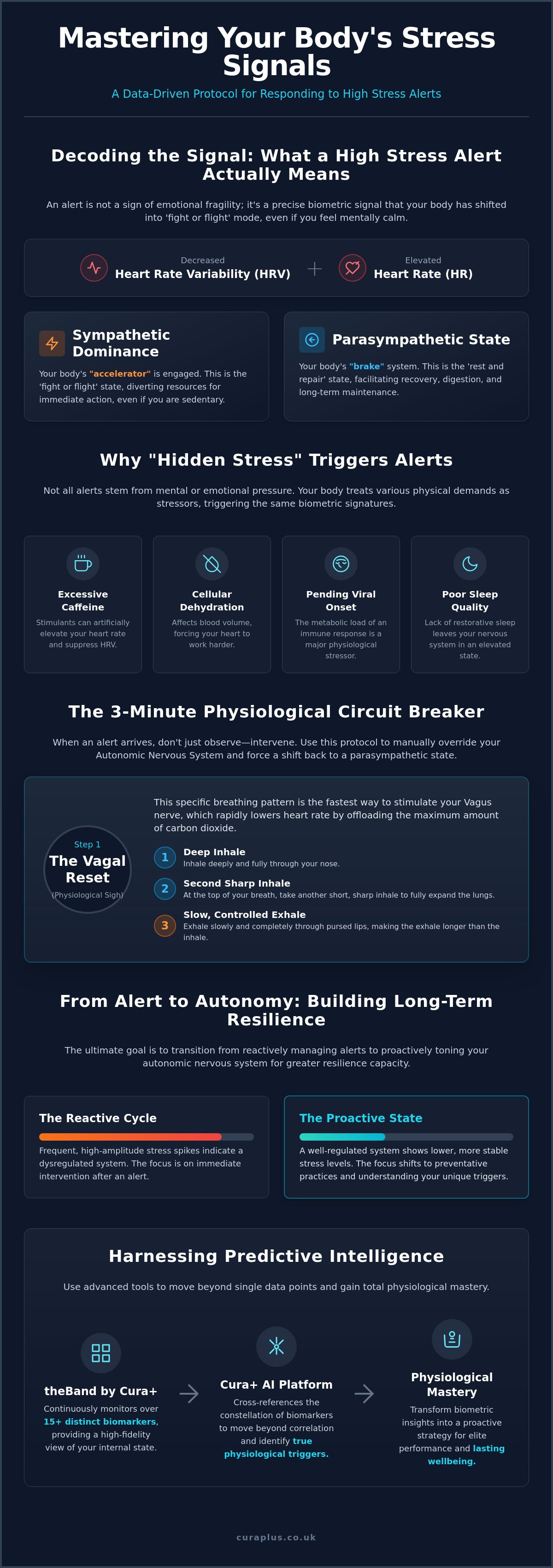
A high stress alert is not a subjective opinion or a suggestion of emotional fragility. It is a digital reflection of real-time shifts in your Autonomic Nervous System (ANS). Many users feel a sense of confusion when their wrist buzzes whilst they are simply reading or resting. This occurs because your device is monitoring physiological stress, which often operates independently of your conscious thoughts. A high stress alert is defined as a measurable decrease in HRV paired with elevated heart rate.
Understanding what to do after a high stress alert begins with recognising that your body has entered a state of "Sympathetic Dominance." This is the body's internal "fight or flight" mode, where resources are diverted away from recovery and digestion toward immediate action. Whilst psychological stress involves your worries and narrative thoughts, physiological stress is the raw data of your survival mechanisms in motion. You might feel mentally calm, yet your biometrics reveal a system under significant load.
The Role of the Autonomic Nervous System
Your ANS functions through two primary branches that act like the controls of a high-performance vehicle. The Sympathetic branch is the accelerator, preparing you for exertion or defence through an acute stress response. Conversely, the Parasympathetic branch serves as the brake, facilitating rest, repair, and long-term maintenance.
An alert whilst you are sedentary suggests your accelerator is stuck down despite there being no need for speed. This lack of "physiological intelligence" in the body's response is common in modern environments. Your device identifies this mismatch before you feel it. It gives you a window to intervene before the state becomes chronic. Recognising this signal is the first step toward regaining control over your internal centre.
Why "Hidden Stress" Triggers Alerts
Not all stress alerts stem from a difficult meeting or a looming deadline. Your body treats various physical demands as "hidden" stressors that trigger the same biometric signatures. Common culprits include:
- Excessive caffeine intake or stimulant use.
- Cellular dehydration affecting blood volume.
- The metabolic load of a pending viral onset.
- Poor sleep quality from the previous night.
Using a wearable for tracking immune health can provide the necessary context to these spikes. If your stress levels rise whilst your body temperature also shifts, you may be seeing an early warning of illness rather than emotional tension. Differentiating a one-off spike caused by a double espresso from a systemic trend is vital for accurate health management. When you know what to do after a high stress alert, you stop reacting to the data and start responding to your body's actual needs.
Immediate Physiological Circuit Breakers: How to Reset in Real-Time
When the notification arrives, the objective is to break the physiological feedback loop before it solidifies into chronic tension. Knowing exactly what to do after a high stress alert requires a shift from passive observation to active intervention. You have roughly three minutes to implement a "manual override" of your Autonomic Nervous System. This prioritised protocol is designed to force a parasympathetic shift, effectively applying the biological brakes to your sympathetic drive.
The goal is not to "calm down" through willpower. Instead, you must use physical levers to signal safety to your brain. By changing your posture and respiratory mechanics, you alter the chemical messages being sent to your amygdala. This immediate recalibration prevents the alert from becoming a source of further anxiety, transforming the data into a catalyst for mastery. Whilst these acute interventions are vital, they work most effectively when paired with long-term practices like mindfulness-based stress reduction to build overall nervous system resilience.
Step 1: The Vagal Reset
The quickest way to stimulate the Vagus nerve is through the "physiological sigh." Inhale deeply through your nose, then add a second, shorter sharp inhale at the very top to fully expand the alveoli in your lungs. Follow this with a slow, controlled exhale through pursed lips. This specific pattern offloads a maximum amount of carbon dioxide and rapidly lowers your heart rate.
Alternatively, you can utilise the 4-7-8 technique. Inhale for four seconds, hold for seven, and exhale for eight. The extended exhalation is the critical component. It signals to your brain that you are in a secure environment where survival is not threatened. This simple mechanical shift can lower your stress score in real-time, a change you can monitor directly through theBand's live biometric feed.
Step 2: Environmental Decoupling
Physical space dictates physiological state. If you receive an alert whilst at your desk, you must move. Digital overstimulation and blue light sustain high stress levels by keeping the brain in a state of hyper-vigilance. Standing up and moving just five metres away from your screen breaks the visual and cognitive loop that may be fueling the sympathetic spike.
For a more aggressive reset, use temperature. Splashing cold water on your face or holding an ice pack to your chest triggers the "mammalian dive reflex." This ancient biological response instantly slows the heart rate and redistributes blood flow to the brain and heart. It is the ultimate ANS "reset" button. By combining these environmental shifts with breathwork, you move from being a victim of your data to an active participant in your physiological health.
Beyond the Notification: Analysing Biomarkers to Identify Triggers
To truly understand what to do after a high stress alert, you must look beyond the isolated notification. An alert is merely a single data point in a much larger physiological narrative. Viewing it in isolation is like reading a single word and attempting to understand an entire book. The Cura+ AI Platform allows you to cross-reference this spike with a constellation of other biomarkers, providing the context necessary for precise recalibration. This shift from reactive monitoring to proactive analysis is where true health mastery begins.
Establishing a clear picture of your internal state involves tracking health trends over time. This long-term perspective reveals how your body actually responds to environmental demands. For instance, your stress threshold is heavily dictated by your previous night's sleep quality. A night of fragmented REM or insufficient deep sleep leaves your nervous system in a primed state, making you significantly more susceptible to sympathetic spikes the following day. When you recognise this correlation, a high stress alert becomes a signal to adjust your workload rather than a reason for anxiety.
The HRV and Skin Temperature Connection
A sudden drop in Heart Rate Variability (HRV) combined with a subtle rise in skin temperature is a classic physiological signature. This specific pairing often predicts a viral onset up to 48 hours before physical symptoms manifest. Whilst others might guess at the cause of their discomfort, theBand monitors over 15 biomarkers simultaneously to identify these shifts automatically. By reframing the alert as an early warning system for your immune health, you can prioritise rest and hydration before your performance suffers. It transforms a moment of stress into a strategic opportunity for self-care.
Identifying Lifestyle Stressors
Many triggers for a high stress alert are found in daily routines rather than emotional events. Alcohol consumption, late-night meals, or intensive evening exercise sessions can cause your recovery scores to plummet and your stress levels to remain elevated whilst you sleep. You can use a wearable for tracking stress patterns to audit these behaviours with clinical precision. Even silent factors like cellular dehydration can increase cardiac strain, leading to an alert whilst you are seemingly at rest. This data-driven audit replaces anecdotal guesswork with actionable physiological intelligence, allowing you to refine your lifestyle for peak resilience.
From Alert to Autonomy: Regulating a Dysregulated Nervous System
Mastering your internal state requires moving beyond acute interventions. Whilst the immediate circuit breakers discussed previously are essential, the ultimate goal is to "tone" your nervous system for long-term stability. This involves expanding your Resilience Capacity. This metric represents the volume of physiological load your body can process before triggering a sympathetic spike. A robust system doesn't just recover faster; it remains in a state of parasympathetic composure for longer, even under significant demand. Understanding what to do after a high stress alert is the first step toward building this durable physiological buffer.
High-performing individuals often utilise "Micro-Recoveries" to maintain this autonomy throughout the day. These are intentional, ninety-second windows of stillness scheduled between high-stakes tasks. By proactively lowering your heart rate before it reaches a critical threshold, you prevent the cumulative "stress debt" that leads to evening burnout. To execute this strategy with precision, you must ensure your data is reliable. Consult our guide on choosing a wearable for tracking recovery to ensure your device provides the clinical-grade accuracy required for such nuanced self-regulation.
Building Nervous System Resilience
Resilience is a physical attribute that can be trained. Engaging in consistent Zone 2 cardiovascular exercise and deliberate cold exposure are two of the most effective methods for improving Heart Rate Variability (HRV). These practices "stress the stress response," teaching your Autonomic Nervous System to return to a baseline of calm more efficiently. Furthermore, strict sleep hygiene centres your physiological baseline, ensuring you begin each day with a full tank of adaptive energy. Active rest, such as a focused walk without digital distractions, is far superior to passive scrolling, which often sustains a state of low-level hyper-vigilance.
Cognitive Reframing of Physiological Data
The narrative you attach to your biometrics dictates your emotional response. Instead of internalising an alert as "I am anxious," reframe it as "My body is mobilising resources for a challenge." This cognitive shift transforms a perceived threat into a state of readiness. You can use the Cura+ AI dashboard to visualise your progress in stress regulation over months rather than days. A "perfect" stress score is not the objective. Instead, aim for a responsive, adaptable system that can pivot between high-intensity effort and deep restorative rest with ease. Optimise your nervous system with the Cura+ AI Platform to gain total clarity over your physiological evolution.
theBand by Cura+: Mastering Your Stress Response with Predictive Intelligence
Having a structured protocol for what to do after a high stress alert is essential, but having a device that contextually understands that alert is transformative. theBand by Cura+ is far more than a standard tracker; it functions as a sophisticated biological consultant for the human body. Whilst common wearables often provide a generic "stress score" based on limited inputs, theBand monitors over 15 biomarkers simultaneously. This high-fidelity data stream allows the Cura+ AI Platform to distinguish between a healthy sympathetic spike from physical exertion and a dysregulated alert caused by systemic load or hidden stressors.
The true value of this technology lies in its ability to turn raw data into a narrative of self-optimisation. Instead of reacting to a notification with uncertainty, you are empowered with the exact physiological intelligence needed to recalibrate. This approach ensures that you remain in calm control, using each data point as a tool for refinement rather than a source of anxiety. It is the definitive solution for those who view health as a complex system to be mastered through precision and insight.
Precision Monitoring for High-Stakes Health
In a market saturated with devices that offer occasional "snapshots," theBand prioritises continuous, medical-grade monitoring. This level of accuracy is required for professional health management where subtle shifts in HRV or skin temperature can signal significant changes in your internal state. The system is designed to learn your unique physiological baseline over weeks of consistent use. This personalised learning reduces notification fatigue by ensuring you only receive alerts when your biometrics significantly deviate from your personal norm. It turns the ambiguity of what to do after a high stress alert into a structured, data-backed response that is unique to your biology.
Your AI Health and Wellness Coach
The integration of theBand with the Cura+ AI Platform synthesises complex biological signals into simple, actionable daily instructions. It moves beyond the "what" of your data to explain the "why," providing a predictive health wearable UK experience that was previously inaccessible to the public. The platform acts as a strategist, helping you identify which lifestyle factors are driving your stress and which interventions are most effective for your recovery.
We are witnessing a fundamental shift in the future of personal health, moving away from reactive medicine toward predictive intelligence. By choosing theBand, you are investing in a visionary partner for your journey toward peak performance. Secure your place in the future of wellness by exploring theBand today and transform your relationship with your body’s data forever.
Mastering Your Physiological Evolution
You've moved from being a passive observer of your data to an active architect of your physiology. By reframing the high stress alert as a precise biological signal, you strip away the uncertainty that often fuels health anxiety. You now possess the protocol to reset your nervous system in real-time and the analytical framework to identify the lifestyle triggers that demand your attention. Each notification is no longer a disruption; it's a strategic data point for your long-term wellbeing.
Understanding exactly what to do after a high stress alert is the cornerstone of modern wellness. It allows you to transition from reactive management to a state of predictive autonomy. theBand provides this clarity by monitoring 15+ essential biomarkers and delivering AI-driven predictive health alerts. Designed and engineered in the UK, it's the ultimate tool for those committed to physiological excellence. Discover theBand by Cura+: The Future of Predictive Health Intelligence
Your journey toward elite health is no longer a matter of guesswork. It is a methodical, data-driven evolution. Embrace the clarity that comes with mastery and step into the future of proactive wellness today.
Frequently Asked Questions
Is a high stress alert a sign of an anxiety attack?
No, a high stress alert is a biometric measurement of your sympathetic nervous system activity rather than a clinical diagnosis of an anxiety attack. Whilst an anxiety attack is a psychological and physical event, an alert simply indicates that your heart rate variability has decreased and your heart rate has risen. It signals a shift into a "fight or flight" state that may or may not be accompanied by conscious feelings of panic.
Why is my stress alert high when I am just sitting down or resting?
Physiological stress often operates independently of physical movement or conscious thought. Your body may trigger a sympathetic response due to metabolic demands, cellular dehydration, or even the cognitive load of a complex task. If you are sedentary and receive an alert, it suggests your internal "accelerator" is active despite a lack of external demand, which is a key indicator of a dysregulated nervous system.
Can a high stress alert predict that I am getting sick?
Yes, your wearable can often serve as an early warning system for your immune health. A sustained drop in heart rate variability combined with a subtle rise in skin temperature frequently precedes the onset of physical symptoms by up to 48 hours. Recognising this pattern allows you to prioritise rest and hydration before a viral onset fully impacts your performance and wellbeing.
How accurate are wearable stress alerts compared to clinical tests?
Wearable devices are designed to track long-term physiological trends rather than provide one-off clinical diagnoses. A 2025 study noted that whilst moment-to-moment emotional accuracy can vary, these devices are highly reliable for monitoring autonomic balance and recovery trends over time. They provide a sophisticated baseline that helps you understand your body’s unique responses to various environmental stressors.
Should I be worried if my stress score is high every day?
Consistently high scores suggest that your "Resilience Capacity" is being frequently exceeded, which warrants a systemic audit of your lifestyle. It indicates a lack of sufficient recovery rather than a single acute event. Instead of worrying, use this data to refine your sleep hygiene and workload, ensuring you give your nervous system the necessary windows for parasympathetic restoration.
What is the best way to lower my stress score immediately?
Physical intervention is the most effective strategy for knowing what to do after a high stress alert to force a rapid physiological shift. Implementing the "physiological sigh"—a double inhale followed by a long, controlled exhale—instantly signals safety to the brain and lowers the heart rate. Combining this with a brief period of environmental decoupling, such as moving away from your desk, provides a powerful autonomic reset.
How does theBand by Cura+ track stress differently from other wearables?
theBand provides a more comprehensive view of your health by monitoring over 15 biomarkers simultaneously. Unlike standard trackers that rely solely on heart rate, theBand and the Cura+ AI Platform cross-reference multiple data points to provide deep context. This multi-metric approach allows the system to distinguish between healthy exertion and genuine physiological strain with clinical-grade precision.
Can caffeine or alcohol trigger a high stress alert?
Yes, both caffeine and alcohol are significant physiological stressors that directly impact your biometric data. Caffeine stimulates the sympathetic nervous system, often causing a spike in heart rate even whilst you are resting. Alcohol is particularly disruptive as it significantly reduces heart rate variability and prevents your body from entering deep, restorative sleep, leading to elevated stress scores the following day.


