


Your body knows you're falling ill long before your consciousness registers the first tickle in your throat or a rise in temperature. For many in the UK, the frustration of catching a virus too late to mitigate its impact is a recurring cycle that disrupts both professional performance and personal well-being. You likely feel that once symptoms appear, the battle for your health is already half-lost. This article explores the sophisticated science behind how technology can predict illness, moving beyond the basic steps and sleep tracking of yesterday. We'll demystify the complex world of digital biomarkers and explain how advanced sensors identify the minute physiological deviations that signal trouble days in advance.
We'll provide clarity on the distinction between consumer-grade fitness trackers and the medical-grade predictive tech required for true health optimisation. You'll discover how the Cura+ AI Platform transforms raw data from theBand into actionable intelligence, allowing you to intercept illness before it takes hold. By understanding the intersection of biology and data-driven algorithms, you can replace the anxiety of invisible health changes with the confidence of clinical precision. This is the future of proactive health in 2026, where we treat the body as a complex system to be mastered rather than a series of symptoms to be managed.
Key Takeaways
- Shift your perspective from reactive "sick care" to a proactive health intelligence model that focuses on long-term prevention rather than just symptom management.
- Gain a deep understanding of how technology can predict illness by tracking the subtle physiological shifts, such as skin temperature and blood flow, that precede physical symptoms.
- Learn how AI algorithms decode your body's deviations by establishing a personalised biological baseline to identify potential health risks with clinical precision.
- Identify practical ways to use data-driven alerts to prevent burnout and viral downtime by recognising early warning signs up to 48 hours before they become critical.
- Discover the unique capabilities of theBand and the Cura+ AI Platform in monitoring over 15 biomarkers to provide a sophisticated, high-level map of your internal health.
What is Predictive Health Technology?
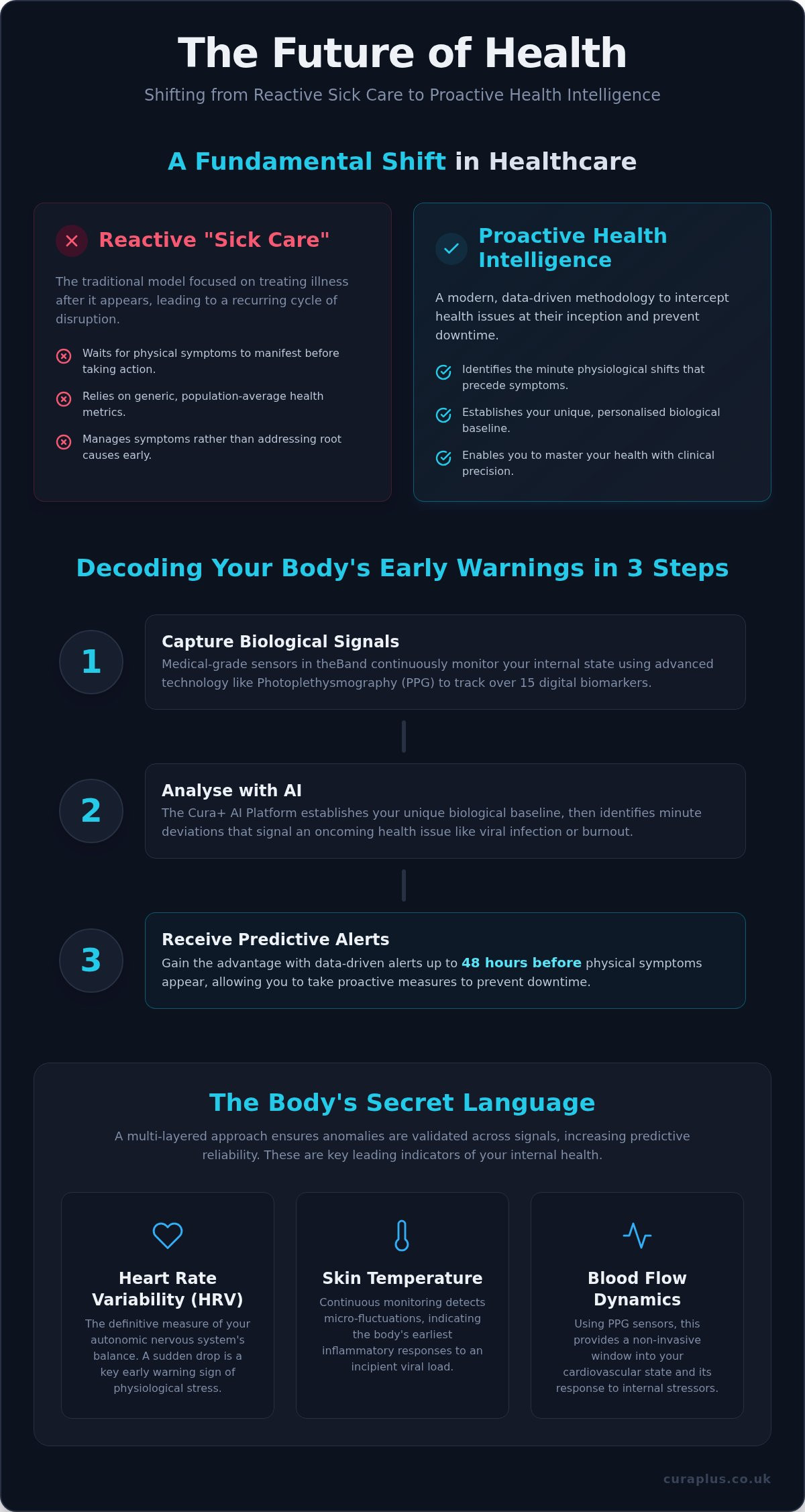
Predictive health is the strategic application of longitudinal data to identify physiological shifts before clinical symptoms manifest. It represents a fundamental shift in how technology can predict illness by moving away from the traditional "sick care" model, where intervention only begins after pain or dysfunction occurs. Instead, we embrace "health intelligence," a methodology rooted in Predictive medicine that treats the human body as an evolving, complex data set. By monitoring subtle changes in real-time, we can intercept health issues at their inception.
The foundation of this approach lies in digital biomarkers. These are objective, quantifiable physiological measures collected via advanced sensors. The most critical early warning signals often originate within the autonomic nervous system (ANS). Because the ANS regulates involuntary functions like heart rate variability and skin conductance, it reacts to internal stressors, such as an incipient viral load, days before you feel your first symptom. It's the body's internal radar, and technology is finally sensitive enough to read its signals.
The Evolution from Fitness Tracking to Health Intelligence
Wearables have matured significantly over the last decade. Early devices were limited to retrospective data; they simply told you how many steps you took or how many hours you slept the night before. By 2026, the focus has shifted entirely to prospective data. We're no longer just looking back at what happened; we're looking forward at what will happen. This turning point allows consumer-accessible tech to monitor complex biology with the same clinical rigour once reserved for laboratory settings, turning raw numbers into predictive foresight.
The Core Philosophy of Proactive Healthcare
True longevity requires a shift in personal agency. Relying on "average" health metrics is no longer sufficient for those seeking peak performance. Utilising proactive health management tools is essential because they establish your unique biological baseline. Everyone's "normal" is different. Technology empowers you to master your biological future by identifying anomalies specific to your own body, rather than comparing your data to a generic population mean. It's about moving from uncertainty to total clarity.
The Biological Signal: How Sensors Capture Early Warning Signs
To understand how technology can predict illness, we must look beneath the surface of the skin at the intersection of physics and biology. The primary mechanism for this insight is photoplethysmography (PPG). This process involves emitting specific wavelengths of light into the tissue and measuring the intensity of the light reflected back. Because blood absorbs more light than the surrounding tissue, fluctuations in light intensity directly correlate with blood flow volume and pulse wave morphology. It's a non-invasive window into your cardiovascular state. When these sensors are medical-grade, they provide the high-fidelity data streams necessary to power complex predictive models with clinical accuracy.
Skin temperature serves as another critical leading indicator for immune system activation. Whilst a traditional thermometer only registers a fever once it's already established, continuous peripheral temperature monitoring identifies the micro-fluctuations that occur during the body's earliest inflammatory responses. By tracking over 15 distinct biomarkers simultaneously, theBand creates a holistic map of your internal environment. This multi-layered approach ensures that an anomaly in one metric, such as a slight temperature rise, is validated by others, significantly increasing the reliability of the predictive intelligence. Investing in medical-grade hardware ensures you're working with data that reflects your true physiological state.
Heart Rate Variability (HRV): The Body’s Secret Language
Heart Rate Variability (HRV) is the definitive measure of the variation in time between each consecutive heartbeat. It isn't just a heart health metric; it's a direct reflection of the balance within your autonomic nervous system. A sudden, unexplained drop in your personalised HRV baseline is often the first signal that your body is redirecting resources to fight an emerging threat. Within the framework of biometric tracking for wellness, HRV acts as the primary predictive pillar, alerting you to internal stress long before you feel fatigued or unwell.
Respiratory Rate and Blood Oxygen Saturation
Nocturnal monitoring provides the cleanest data because it eliminates external variables like movement, caffeine, and emotional stress. An elevated respiratory rate whilst at rest is a classic early indicator of respiratory infections or systemic strain. When this is paired with blood oxygen saturation (SpO2) levels, the system can validate immune system stress with remarkable precision. Monitoring these metrics during sleep allows the Cura+ AI Platform to identify deviations from your norm, providing a secondary layer of validation that confirms whether your body is effectively recovering or beginning to struggle.
AI and Pattern Recognition: Decoding the Body’s Deviations
Raw data is meaningless without a sophisticated engine to interpret it. Whilst the sensors in theBand capture the signals, the Cura+ AI Platform serves as the central intelligence that translates these numbers into foresight. This is exactly how technology can predict illness; it identifies the subtle, non-linear patterns in your biology that the human mind cannot perceive. By processing multi-variate data streams across 15+ biomarkers, the AI distinguishes between normal fluctuations and genuine physiological threats. Sophisticated machine learning models are trained to filter out environmental noise, ensuring that a rise in heart rate from a stressful meeting isn't confused with the onset of a fever.
Anomaly detection is the core of this predictive capability. The system doesn't look for a generic "unhealthy" state; it looks for deviations from your specific mathematical norm. This high-level refinement significantly reduces false positives, which are common in basic wearables that rely on rigid, population-wide thresholds. Instead of alerting you every time your heart rate climbs, the AI understands the context of your movement, sleep quality, and recovery trends. It provides a level of clinical precision that transforms raw biometrics into a strategic health advantage.
Establishing Your Health Baseline
Your body is a unique system with its own idiosyncratic rhythms. Comparing your data to a generic population average is fundamentally flawed because what's "normal" for one individual might indicate a crisis for another. This is why the first 14 days of wearing theBand are vital. This initial fortnight allows the AI to calibrate to your circadian cycles, hormonal shifts, and resting heart rate patterns. You must build a health baseline to provide the system with a reliable point of comparison. Without this personalised foundation, predictive accuracy is impossible.
The Power of Predictive Alerts
Detecting a health shift during the "incubation phase" is where the AI health and wellness coach proves its value. During this window, your body is already fighting a viral load or responding to systemic strain, yet you don't feel "ill" in the traditional sense. Predictive analytics in personal wellness is the mathematical forecasting of future health states by identifying statistically significant deviations from an individual's established physiological baseline. A proactive alert isn't just a notification that a metric has changed; it's a data-driven instruction to adjust your behaviour, prioritise rest, or increase hydration before a minor deviation becomes a major disruption.
Practical Applications: From Viral Detection to Stress Management
The ultimate utility of predictive health lies in its real-world impact. For instance, during recent health crises, research demonstrated that physiological anomalies often manifest up to 48 hours before a user reports any outward symptoms. This is the tangible reality of how technology can predict illness. By synthesising data from skin temperature, resting heart rate, and respiratory patterns, the system identifies the "pre-symptomatic" phase with remarkable accuracy. This window is vital; it's the difference between unknowingly spreading a virus and taking immediate, isolated action to protect your colleagues and family.
Beyond acute infections, these tools are indispensable for managing the "invisible" creep of chronic strain. Longitudinal trend analysis allows you to observe if your physiological recovery is keeping pace with your daily demands. Similarly, shifts in your sleep architecture, such as a persistent reduction in deep sleep or fragmented REM cycles, often serve as leading indicators for impending mental fatigue or physical burnout. You're no longer reacting to a tired morning; you're observing a systemic decline in your capacity to recover before it becomes a crisis.
Monitoring Your Immune Health Proactively
An immune challenge triggers a cascade of measurable events within the body. You might see a subtle rise in nocturnal temperature paired with a tightening of heart rate variability and a slight increase in your resting respiratory rate. Learning how to use a wearable for tracking immune health allows you to interpret these biomarker clusters accurately. When theBand identifies such an anomaly, the most effective response is "pre-emptive rest." By reducing your physiological load before you feel sick, you often shorten the duration of the illness or bypass the most debilitating symptoms entirely.
Stress and Recovery Optimisation
Psychological stress is a measurable physiological event that directly suppresses your immune function. Predictive technology tracks the impact of a high-pressure week on your autonomic nervous system, showing you exactly how much restoration you require to return to your baseline. Utilising a wearable for tracking recovery helps you decide when to push for a new personal best and when to pause for active restoration. This alignment with your natural circadian rhythms ensures you remain resilient against the stressors of modern life. To begin mastering your internal data, explore the precision of theBand and the Cura+ AI Platform.
Embracing a Proactive Future with theBand by Cura+
The transition from reactive medicine to predictive intelligence is no longer a distant vision; it's a tangible reality accessible through theBand. As the pinnacle of UK-based predictive health hardware, theBand is engineered to bridge the gap between laboratory-grade diagnostics and daily wearable technology. Whilst basic devices often provide a surface-level overview, this system monitors over 15 distinct biomarkers with clinical precision. Understanding how technology can predict illness requires hardware that captures the body's most delicate signals, and theBand delivers exactly that. It's the physical foundation upon which your personal health mastery is built.
The true power of this hardware is unlocked through its synergy with the Cura+ AI Platform. This digital "brain" processes your unique data streams in real-time, identifying the mathematical deviations that signal a shift in your physiological state. You aren't just wearing a tracker; you're engaging with a sophisticated ecosystem designed to replace uncertainty with data-driven clarity. We invite you to join our pre-launch phase and become an early adopter of a system that views health as a complex system to be mastered rather than a series of symptoms to be managed.
Why theBand is Different from Standard Trackers
Most consumer wearables rely on simplified algorithms and low-fidelity sensors that often miss the subtle nuances of your biology. theBand is fundamentally different. It utilises high-fidelity sensors and clinical-grade data processing to ensure every data point is accurate and actionable. Beyond raw measurement, the system integrates real-time health coaching based on your specific predictive insights, providing immediate guidance when your baseline shifts. We also prioritise your data privacy, employing sophisticated biometric security to ensure your health intelligence remains exclusively yours.
Taking the Next Step in Your Health Journey
Preparing for the future of wellness means shifting your mindset today. By embracing continuous, proactive health monitoring, you gain the ability to intercept downtime and optimise your performance with surgical accuracy. The long-term benefits of this data-driven approach extend far beyond viral detection; it's about building a longitudinal map of your biological potential. You can discover the future of personal health and secure your place in the predictive era by joining the Cura+ community. Don't wait for symptoms to dictate your life when you can master your biology now.
Mastering Your Biological Future
The transition from reactive sick care to proactive health mastery is defined by the quality of your data. We've explored the sophisticated biological mechanisms and AI algorithms that define how technology can predict illness, moving beyond the limitations of standard consumer trackers. By establishing a personalised baseline and monitoring over 15 distinct biomarkers, you gain the clarity needed to intercept health challenges before they disrupt your life. This is the new standard for those who view health as a complex system to be understood with clinical precision.
theBand and the Cura+ AI Platform represent the pinnacle of this revolution. Designed and developed in the UK, our system provides the AI-driven proactive health intelligence required to navigate the demands of 2026 with total confidence. You don't have to wait for symptoms to manifest before taking command of your well-being. It's a journey toward self-optimisation that starts with data and ends with empowered control.
Register your interest for theBand by Cura+ and lead the predictive revolution
The future of your health is no longer an invisible mystery; it's a data-driven narrative waiting for you to lead it.
Frequently Asked Questions
How far in advance can technology predict a viral illness?
Advanced predictive models can identify the onset of viral illness up to 48 hours before physical symptoms become apparent. This early detection window is made possible by tracking minute physiological shifts that occur during the incubation phase. By identifying these deviations early, you gain a critical advantage in managing your recovery and preventing the spread of infection to others. It's about moving from a reactive state to one of informed, calm control over your well-being.
Which biomarkers are the most important for predicting sickness?
Heart rate variability (HRV), peripheral skin temperature, and resting respiratory rate are the most significant biomarkers for sickness prediction. HRV serves as a direct window into your autonomic nervous system's stress levels, whilst skin temperature micro-fluctuations often signal early inflammatory responses. When monitored simultaneously, these metrics provide a high-fidelity map of how technology can predict illness with precision. This multi-layered approach ensures that your health intelligence is based on verified biological signals rather than guesswork.
Can a wearable device detect COVID-19 before symptoms appear?
Research has demonstrated that wearables can detect the physiological signatures of viral infections like COVID-19 up to two days before symptoms appear. The system identifies specific clusters of anomalies, such as an elevated resting heart rate paired with a drop in blood oxygen saturation. Whilst theBand doesn't provide a clinical medical diagnosis, it offers the proactive intelligence needed to seek testing or isolate earlier. This foresight empowers you to protect your community and manage your health.
Is predictive health technology accurate enough to rely on?
The accuracy of predictive health technology depends on the quality of the sensors and the sophistication of the algorithms. theBand utilises medical-grade hardware to ensure data fidelity, reducing the risk of errors found in basic consumer trackers. By establishing a personalised baseline rather than relying on population averages, the Cura+ AI Platform delivers highly reliable insights. You can trust the data to reflect your true physiological state, allowing you to make informed decisions about your daily activity.
How does theBand by Cura+ establish my health baseline?
Establishing your health baseline requires a 14-day calibration period during which theBand monitors your circadian rhythms, sleep architecture, and resting biometrics. This initial fortnight allows the AI to understand your body's specific normal state across various conditions. Once this foundation is set, the system can accurately identify even the most subtle deviations that might indicate emerging health issues. This personalised approach ensures that every alert you receive is relevant to your unique biological profile.
Will I get false alarms if I am just tired or stressed?
The Cura+ AI Platform is designed to distinguish between acute environmental stressors and the onset of illness. Whilst a stressful day might trigger a temporary shift in your metrics, the system looks for specific, sustained patterns across 15+ biomarkers before issuing an alert. This multi-variate analysis ensures that false alarms are minimised, providing you with clarity rather than unnecessary anxiety. You'll receive alerts that are statistically significant, allowing you to focus on genuine recovery when it matters.
Do I need a doctor to interpret my predictive health data?
You don't need medical training to understand your data because the Cura+ AI Platform translates complex biometrics into actionable intelligence. The system provides clear, sophisticated guidance on what your data means for your daily performance and recovery. It's important to remember that whilst these tools offer mastery over your health data, they don't replace professional medical advice for clinical diagnosis. Think of it as a high-level consultant for your body that keeps you informed and ahead of the curve.
What should I do when my device predicts I am getting ill?
When your device signals an impending illness, the most effective strategy is to prioritise pre-emptive rest and increased hydration immediately. Reducing your physiological load before symptoms peak can often shorten recovery times or lessen the severity of the illness. This proactive approach is a core element of how technology can predict illness to help you maintain peak performance. By acting on data-driven alerts, you replace uncertainty with a strategic plan to protect your long-term health and productivity.


