


What if your body could signal a coming fever days before you actually felt the first shiver? For most people, health remains a reactive game played only once physical symptoms arrive. You likely recognise the frustration of waking up exhausted, wondering if you are truly falling ill or simply recovering from a demanding week. Integrating a wearable for tracking skin temperature into your daily routine changes this dynamic by offering a visionary window into your internal state. It transforms subtle physiological shifts from invisible background noise into a precise, predictive map of your immune health.
You already understand that data is only valuable when it provides absolute clarity. This article explores the sophisticated science behind continuous thermal monitoring and how it connects to your broader biomarkers. We will examine how to move beyond the confusing metrics of generic trackers to establish a definitive physiological baseline. You will discover how theBand and the Cura+ AI platform empower you to identify illness before symptoms start; this allows you to maintain calm control over your health whilst pursuing peak performance.
Key Takeaways
- Understand how thermoregulation serves as a primary biological defence, allowing you to identify the incubation window of illness before symptoms appear.
- Evaluate the precision of different sensor technologies to ensure your wearable for tracking skin temperature remains accurate despite environmental noise.
- Learn the exact protocol for establishing a personalised physiological baseline over 14 days to distinguish meaningful data from daily fluctuations.
- Discover how integrating thermal data with 15 other biomarkers via theBand and Cura+ AI Platform provides a visionary map of your total health.
Why Skin Temperature is the New Vital Sign for 2026
In 2026, the definition of a vital sign has expanded beyond the traditional quartet of pulse, respiration, blood pressure, and core temperature. We've entered an era where the surface of our skin provides a rich, real-time narrative of our internal physiological state. Whilst traditional thermometers offer a static spot-check of health, a modern wearable for tracking skin temperature captures the subtle, rhythmic fluctuations that occur throughout the circadian cycle. This shift from reactive measurement to continuous data collection allows for a level of predictive insight that was previously reserved for clinical settings.
Skin Temp vs. Core Temp: Understanding the Difference
It's vital to distinguish between core body temperature and the readings captured at the skin's surface. Your core temperature is tightly regulated by the hypothalamus to protect vital organs, staying remarkably consistent. In contrast, normal human skin temperature is far more dynamic. It acts as a primary interface between your internal biology and the external environment. The autonomic nervous system constantly adjusts blood flow to the skin to manage heat dissipation, making surface temperature a highly sensitive indicator of stress, inflammation, and metabolic shifts. By measuring distal temperature, which is the heat at your extremities, wearable technology can detect systemic changes long before they manifest as a systemic fever.
The technological landscape of 2026 has resolved previous challenges regarding sensor accuracy. Early wrist-worn devices often struggled with noise from ambient air or movement. However, the latest generation of sensors, such as those found in theBand, utilise advanced heat flux thermistors that isolate the body's thermal output from external variables. This precision is essential because your skin temperature is a direct reflection of your autonomic nervous system's behaviour. When your immune system begins to mobilise against a pathogen, your body's thermoregulatory patterns change. These deviations serve as a visionary early-warning system, replacing guesswork with data-driven clarity.
The Evolution of Health Wearables in the UK
The British health tech sector has moved decisively away from basic step counting towards sophisticated, multi-biomarker analysis. We're no longer satisfied with knowing how far we've walked; we want to know how well our bodies are recovering. Continuous monitoring identifies patterns that are invisible to the human eye, such as a steady rise in overnight skin temperature that may precede a viral infection. By integrating these thermal insights with the Cura+ AI Platform, users can transition from being passive observers of their health to active, proactive managers of their physiological wellbeing. This is the new standard for self-optimisation in 2026.
The Biological Link Between Skin Temperature and Your Immune System
Thermoregulation is a sophisticated biological strategy. It acts as a primary barrier against viral and bacterial threats, serving as a tactical deployment of energy. When your body detects a pathogen, it initiates a complex cascade of immune responses that immediately alter peripheral blood flow. This is where a wearable for tracking skin temperature becomes indispensable. By capturing these minute shifts in surface heat, the technology provides a real-time window into your body’s defensive posture. It allows you to observe the quiet mobilisation of your immune system long before you feel the first signs of fatigue.
Early Illness Detection: The Predictive Power of Heat
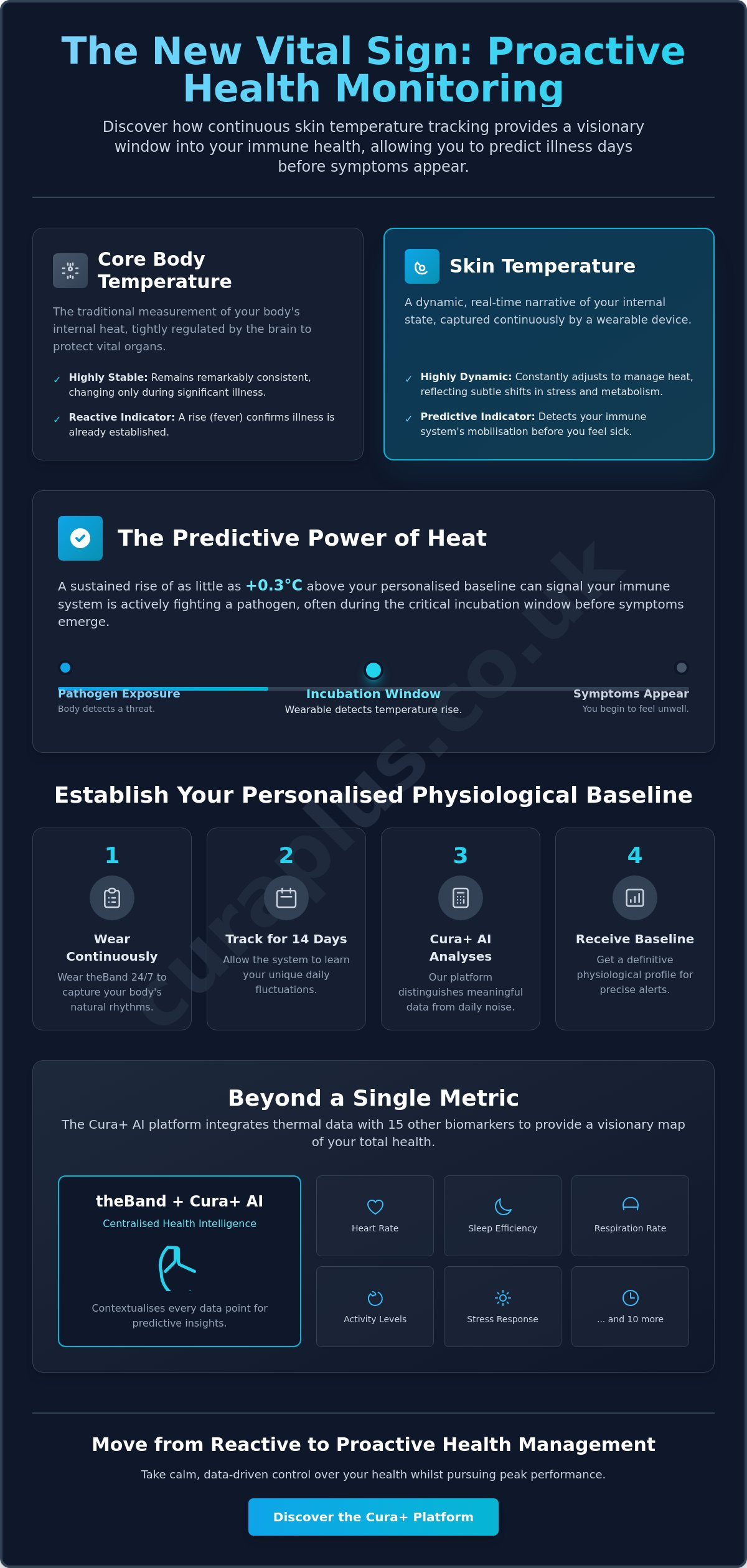
A rise of as little as 0.3°C above your personalised baseline can signal that your immune system is actively mobilising. This thermal shift often occurs during the incubation window, the critical period before physical symptoms like a cough or congestion emerge. Research from Stanford Medicine suggests that wearable sensors can detect the onset of infection by identifying these subtle deviations in heart rate and temperature. When these spikes are paired with a decrease in sleep efficiency, the data provides a clear warning. This makes theBand an essential wearable for tracking immune health, offering the clarity needed to prioritise rest whilst you are still asymptomatic. Identifying inflammation through localised or systemic thermal rises allows for proactive intervention rather than reactive treatment.
Stress, Recovery, and Thermal Regulation
Thermal regulation is not solely a proxy for illness; it is a direct reflection of systemic recovery and autonomic balance. Chronic stress impairs the body's ability to regulate heat efficiently, often leading to elevated nocturnal temperatures that prevent deep rest. When you utilise a wearable for tracking recovery, you begin to see how specific lifestyle choices impact your thermal baseline. Alcohol consumption, late-night meals, and high-intensity exercise late in the evening all force the body to work harder to maintain homeostasis. These factors disrupt the natural thermal dip required for restorative sleep, leaving you less prepared for the demands of the following day.
Understanding these nuances allows you to master your internal environment with clinical precision. If your wearable for tracking skin temperature shows a persistent elevation, it is a definitive signal to adjust your training load or increase your sleep duration. For those seeking the highest level of physiological insight, theBand provides the accuracy necessary to transform raw data into a sophisticated recovery strategy. By monitoring these trends, you replace uncertainty with the calm control of data-driven wellness.
Comparing Sensor Technologies: How Wearables Track Thermal Fluctuations
Precision in biometric monitoring depends entirely on the underlying hardware architecture. Not all sensors are created equal; the method by which a device captures thermal data determines its utility as a predictive tool. Whilst many consumer devices rely on basic components, a professional-grade wearable for tracking skin temperature must distinguish between true biological signals and environmental interference. This technical integrity is what separates a simple gadget from a sophisticated health consultant.
Infrared (IR) sensors and heat flux thermistors represent the two primary technologies in this space. IR sensors measure radiated heat, a method often used in non-contact thermometers. However, they are highly susceptible to "noise" from ambient air and movement. In contrast, heat flux thermistors measure the actual transfer of heat between the skin and the sensor. This contact-based approach is significantly more reliable for continuous monitoring, as it maintains data integrity regardless of sleeve position or physical activity. Peer-reviewed research highlights that devices which continuously track physiological data are far more effective at identifying the early markers of systemic stress. This high-frequency sampling is the hallmark of an advanced wellness tracker designed for 2026.
The Role of Ambient Temperature Compensation
The external environment presents a constant challenge to data accuracy. A predictive health wearable UK users rely on must account for the unpredictable British climate, where a damp morning commute followed by a heated office environment can create false spikes in raw data. Advanced AI algorithms within the Cura+ platform filter out this "room noise" by comparing skin temperature against ambient sensors. This process transforms raw, erratic readings into "insight-ready" information, ensuring that the alerts you receive are based on your biology rather than the weather.
Battery Life vs. Sensor Frequency
Engineering a device for continuous overnight monitoring requires a delicate balance between power consumption and sampling frequency. Once-an-hour readings are insufficient for predictive health because they miss the subtle, rhythmic oscillations of the circadian cycle. Professional-grade sensors must sample data multiple times per minute to establish a true baseline. When choosing a wearable for tracking skin temperature, look for technology that prioritises high-resolution data over mere battery longevity. Meticulous engineering ensures that theBand provides the granular detail necessary for early illness detection without requiring a daily charge, offering a seamless integration into your high-performance lifestyle.
Interpreting Deviations and Establishing Your Physiological Baseline
Data without context is merely noise. Whilst population averages provide a broad framework for health, they often fail to capture the nuances of your unique biology. A temperature reading that appears "normal" by general standards could actually represent a significant physiological shift for you. This is why a wearable for tracking skin temperature must be used to establish a personalised baseline. By understanding your body's specific thermal signature, you move away from generic health tracking and towards a model of clinical precision tailored to your own internal rhythms.
The foundation of predictive health is the baseline. To build a health baseline, you should monitor your metrics consistently over a 14-day period. This timeframe is essential because it accounts for the natural variance in your lifestyle, including work-related stress, physical exertion, and dietary habits. During this window, your wearable for tracking skin temperature learns to distinguish between a "one-off" spike caused by a warm room and a sustained trend that indicates an immune response. This longitudinal view is what allows the Cura+ AI Platform to identify deviations with visionary accuracy.
True physiological intelligence requires the synthesis of multiple data points. A thermal rise is a powerful indicator, but its meaning becomes much clearer when viewed alongside Heart Rate Variability (HRV). If you notice a rise in skin temperature coupled with a sharp drop in HRV, it is a definitive signal that your body is under systemic strain. Choosing the right device to measure HRV ensures that these two critical biomarkers are synchronised. This intersection provides a comprehensive map of your autonomic nervous system, allowing you to intercept potential health issues before they escalate.
Circadian Rhythms and Nightly Temperature Dips
Your body follows a strict thermal protocol to initiate deep sleep. As evening approaches, your core temperature drops whilst your skin temperature rises to radiate heat away from the body. This cooling process is vital for entering restorative sleep stages. Using a wearable for tracking sleep stages allows you to validate this thermal data against your actual rest quality. Morning readings, taken immediately upon waking, remain the gold standard for baseline consistency because they are least affected by the day's external variables.
When to Take Action Based on Thermal Data
Recognising a significant deviation is the key to proactive wellness. In a data-driven health strategy, a shift of more than 1.5 standard deviations from your 14-day baseline should prompt immediate attention. When you combine these thermal alerts with a wearable for tracking stress patterns, the path forward becomes clear. Practical steps include increasing hydration, prioritising an earlier sleep schedule, and reducing your physical training load. These small, data-backed adjustments can often prevent a minor immune challenge from becoming a full-blown illness. Secure your health with the predictive intelligence of theBand and regain calm control over your physiological future.
Beyond Single Metrics: The Cura+ Approach to Predictive Health Intelligence
A singular data point, however accurate, offers only a partial view of a complex biological system. Whilst a wearable for tracking skin temperature provides a critical early-warning signal, its true power is unlocked when synthesised within a multi-biomarker ecosystem. The future of wellness doesn't rely on isolated measurements but on the sophisticated correlation of disparate signals. By integrating thermal data with other vital metrics, we transition from merely observing our current state to predicting our physiological future with clinical precision.
TheBand serves as the primary gateway to this high-definition health experience. It is a multi-sensor powerhouse designed to monitor over 15 distinct biomarkers simultaneously. This comprehensive approach ensures that every thermal fluctuation is contextualised by heart rate variability, blood oxygen saturation, and respiratory patterns. When these metrics are processed through the Cura+ AI Platform, the result is a visionary map of your total health. It's a shift from reactive monitoring to proactive mastery, where your data identifies systemic shifts before they impact your performance.
The Power of 15+ Biomarkers Working in Unison
Skin temperature is a vital indicator, but it remains only one piece of the predictive puzzle. TheBand identifies complex correlations that are invisible to the human eye, such as the subtle interplay between a rising thermal baseline and a declining oxygen saturation level. This integrated intelligence allows for a level of insight that generic fitness trackers cannot replicate. By utilising an AI health and wellness coach, you receive personalised guidance that evolves with your biology. This specialised system doesn't just present numbers; it offers clear, actionable strategies to optimise your recovery and maintain your immune integrity.
Your Future Health, Visualised
We believe that health data should provide clarity, not confusion. The Cura+ ecosystem replaces overwhelming charts with intuitive, actionable intelligence. You no longer need to wonder what a 0.4°C rise in temperature means for your training schedule; the platform provides the answer in real time. This sophisticated guidance is supported by a commitment to the absolute security and privacy of your biometric data. Your physiological profile is a private asset, and our architecture ensures it remains under your exclusive control whilst providing the insights you need to excel. It's time to move beyond the limitations of traditional tracking. Discover the future of proactive health with theBand by Cura+ and embrace a life of data-driven excellence.
Mastering Your Physiological Future
The transition towards predictive health represents a fundamental shift in how we interact with our own biology. By integrating a wearable for tracking skin temperature into your daily routine, you move beyond the limitations of reactive care. You've discovered that your body signals its needs long before physical symptoms emerge; the key is having the technology to listen. Establishing a precise physiological baseline allows you to distinguish between daily fluctuations and the meaningful thermal deviations that precede systemic stress.
True wellness mastery requires a comprehensive view of the body's internal landscape. TheBand is designed and engineered in the UK to provide this depth, monitoring 15+ critical biomarkers to ensure no signal goes unnoticed. With AI-driven predictive health alerts, you gain a sophisticated partner in your journey toward peak performance. It's time to replace uncertainty with the quiet excitement of data-driven discovery. You possess the intelligence to transform your health from a series of symptoms into a mastered system.
Secure your future health with theBand by Cura+. Your path to optimised wellbeing is already accessible through the power of clinical-grade intelligence.
Frequently Asked Questions
How accurate is a wearable for tracking skin temperature compared to a thermometer?
A wearable for tracking skin temperature measures surface heat, which is fundamentally different from the core body temperature captured by a clinical thermometer. Whilst a thermometer provides a static snapshot of your internal state, a wearable focuses on longitudinal trends and minute deviations from your personal baseline. This continuous data stream is often more valuable for predictive health and early illness detection than a single, medically precise reading taken once a day.
Can my wearable detect a fever before I feel any symptoms?
Yes, these devices can often identify the physiological precursors to a fever during the incubation window. Subtle rises in surface temperature frequently occur as the immune system begins to mobilise against a pathogen. By detecting these shifts early, you can take proactive steps to prioritise rest and hydration before the onset of overt symptoms like muscle aches or congestion.
Why does my skin temperature change so much during the night?
Your skin temperature fluctuates at night as part of your body's natural thermoregulatory process. To initiate deep sleep, your core temperature must drop; your body achieves this by radiating heat through your skin, particularly at the extremities. These nocturnal variations are a healthy sign that your autonomic nervous system is successfully managing your sleep cycles and preparing your body for restorative rest.
What factors besides illness can cause a rise in skin temperature?
Several lifestyle factors can cause thermal elevations that are unrelated to viral infection. Alcohol consumption, high-intensity exercise late in the evening, and heavy meals can all significantly raise your nocturnal temperature baseline. Chronic psychological stress also impacts the autonomic nervous system, leading to persistent deviations that signal a requirement for systemic recovery and stress management.
Is skin temperature tracking only useful for women tracking their cycles?
No, thermal tracking is a vital metric for all individuals seeking to optimise their health. Whilst it is an established tool for monitoring menstrual cycles, its primary value in 2026 lies in predictive immune health and recovery optimisation for everyone. Understanding how your baseline shifts in response to stress and pathogens allows you to make data-driven decisions about your daily training and workload.
How long does it take for a wearable to establish my personal temperature baseline?
It typically takes 14 days of consistent use for a wearable for tracking skin temperature to establish a reliable physiological baseline. This period allows the underlying AI algorithms to understand your unique thermal signature across various environments and activity levels. Once this baseline is established, the system can accurately identify meaningful deviations that warrant your attention whilst ignoring daily noise.
Do I need to wear the device tightly for accurate temperature readings?
Your device should be worn snugly but comfortably to ensure consistent skin contact without restricting circulation. If the sensor is too loose, ambient air can interfere with the readings and create erratic data points. Achieving a secure, stable fit is essential for maintaining the data integrity required for professional-grade health tracking and accurate predictive alerts.
Can environmental factors like a hot room affect my wearable’s data?
External conditions like a heated bedroom can influence raw data, but advanced wearables use AI to compensate for these variables. By comparing your skin temperature against integrated ambient sensors, theBand filters out environmental noise. This process ensures that the insights you receive are a true reflection of your internal biology rather than the temperature of your sleeping environment.


